

Eighteen months after President Donald Trump signed Executive Order 14233, the U.S. Strategic Bitcoin Reserve remains centered on Bitcoin obtained through federal forfeiture proceedings, with no congressional authorization yet in place for a separate large-scale market-purchase program.
The executive order created the Strategic Bitcoin Reserve, directed Treasury to establish an office controlling its custodial accounts, prohibited the sale of Bitcoin deposited into the reserve, and instructed Treasury and Commerce to develop budget-neutral strategies for acquiring additional Bitcoin.
Public trackers currently attribute 328,372 BTC to the U.S. government, worth about $25.3 billion at the latest price shown by BitcoinTreasuries. That figure is a tracker estimate of government holdings, not an audited Treasury statement establishing that every coin has already been transferred into the Strategic Bitcoin Reserve.
The key development in 2026 came on September 16, when the House Financial Services Committee advanced the American Reserve Modernization Act, or ARMA, by 28-21. The bill would formalize Treasury custody, impose a minimum 20-year holding period for qualifying government Bitcoin and require public cryptographic proof-of-reserve reporting. It does not authorize open-market purchases.
The Current U.S. BITCOIN Position Came From Seizures
The government’s Bitcoin holdings were accumulated through law enforcement actions that predated the reserve.
Major cases include roughly 94,000 BTC from the Bitfinex investigation, 50,676 BTC seized from James Zhong, and about 69,370 BTC associated with the Silk Road “Individual X” case. Together, those three cases account for approximately 214,000 BTC.
But the picture changed materially in October 2025.
The Department of Justice filed a civil forfeiture complaint involving approximately 127,271 BTC connected to Prince Group founder Chen Zhi. The DOJ described it as the largest forfeiture action in its history and said the Bitcoin was already in U.S. government custody. The allegations remain subject to the legal process.
That case should be included in any current calculation of U.S. government Bitcoin because it is larger than each of the three major seizures traditionally cited in reserve discussions.
Before the reserve policy, seized Bitcoin could ultimately be sold through the government’s forfeiture process. Executive Order 14233 changed the treatment of qualifying Bitcoin by establishing a policy against selling Bitcoin placed into the reserve.
What Executive Order 14233 Actually Created
The March 6, 2025 order did more than announce a policy preference.
It directed the Treasury Secretary to establish an office to administer and control custodial accounts collectively known as the Strategic Bitcoin Reserve. It also required federal agencies to review their authority to transfer government Bitcoin into the reserve and ordered agencies to provide Treasury with a full accounting of government digital assets.
This is an important correction to the common description that the order created “no custody framework.” It did establish a federal administrative structure.
The unresolved question is different: how completely those holdings have been consolidated, reconciled and publicly reported under one institutional structure.
The White House’s July 2025 digital-assets report confirmed that Treasury would administer the reserve and stockpile while continuing coordination on implementation. It also said Treasury had delivered its considerations to the White House concerning establishment and management of the reserve.
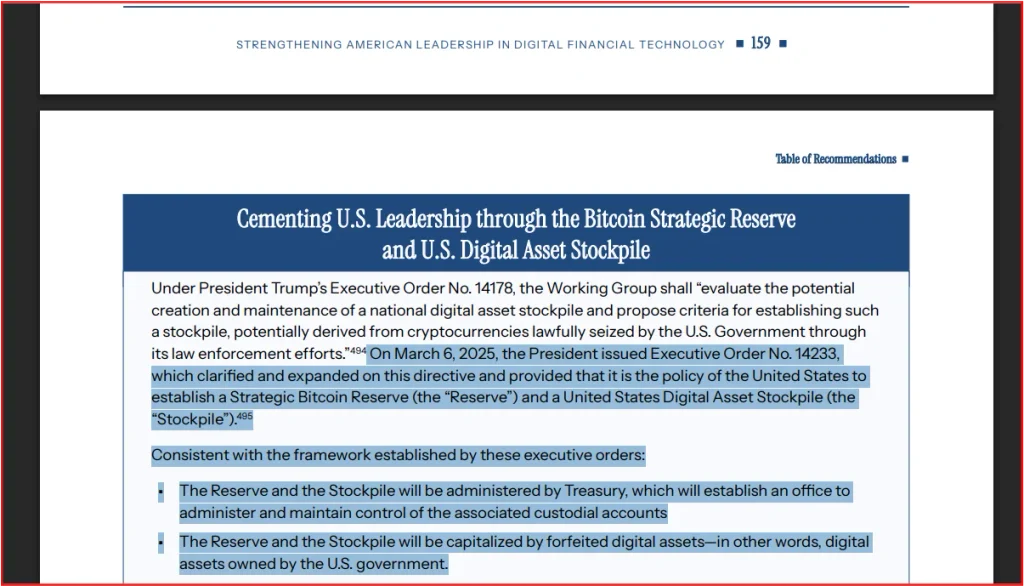
The order also did not authorize a conventional taxpayer-funded Bitcoin buying program. Treasury and Commerce were instructed to explore budget-neutral acquisition strategies. That distinction explains why the reserve can exist while confirmed open-market purchases remain at zero.
BITCOIN Act & ARMA Are Not the Same Bill
The two major federal proposals address different parts of the reserve question.
The BITCOIN Act would establish a program purchasing 200,000 BTC annually for five years, reaching 1 million BTC. The bill text explicitly establishes that purchase program.
ARMA takes a different approach. Its revised version requires Treasury to establish a secure Bitcoin storage facility within 180 days of enactment and creates a separate Digital Asset Stockpile. It also requires quarterly public proof-of-reserve reporting with cryptographic attestation.
ARMA would also require Treasury and Commerce to study ways of acquiring additional Bitcoin without borrowing, new taxation or deficit spending. That is a study mandate, not an authorization for immediate market purchases.
The September 16 ARMA Vote Moved the Custody Question Forward
H.R. 8957 was introduced on May 21, 2026. On September 16, the House Financial Services Committee ordered the amended bill to be reported after a 28-21 vote. It has not become law.
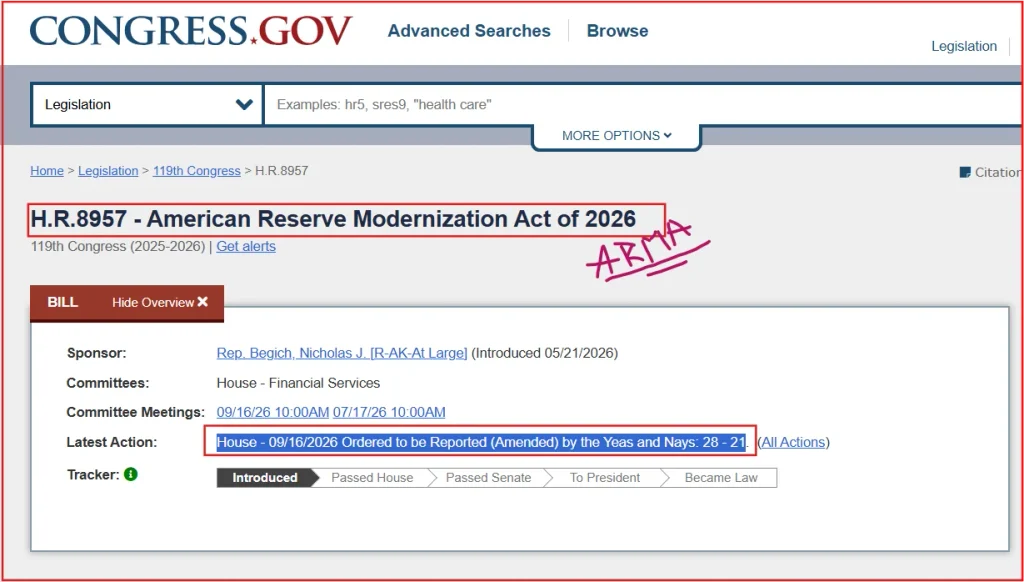
The amended bill retains the 20-year minimum holding period for qualifying government Bitcoin and requires Treasury to publish ongoing proof-of-reserve information. It also protects lawful private ownership and self-custody rights under the bill’s terms.
The distinction matters because the committee action does not mean the federal government has already locked 328,372 BTC for 20 years.
That would depend on the bill becoming law and on which government Bitcoin ultimately qualifies for the reserve under its statutory definitions.
The 328,372 BTC Figure Needs a Qualification
The headline number is useful, but it should not be presented as an audited reserve balance.
BitcoinTreasuries currently lists 328,372 BTC as U.S. government holdings, equivalent to about 1.56% of Bitcoin’s 21 million maximum supply.
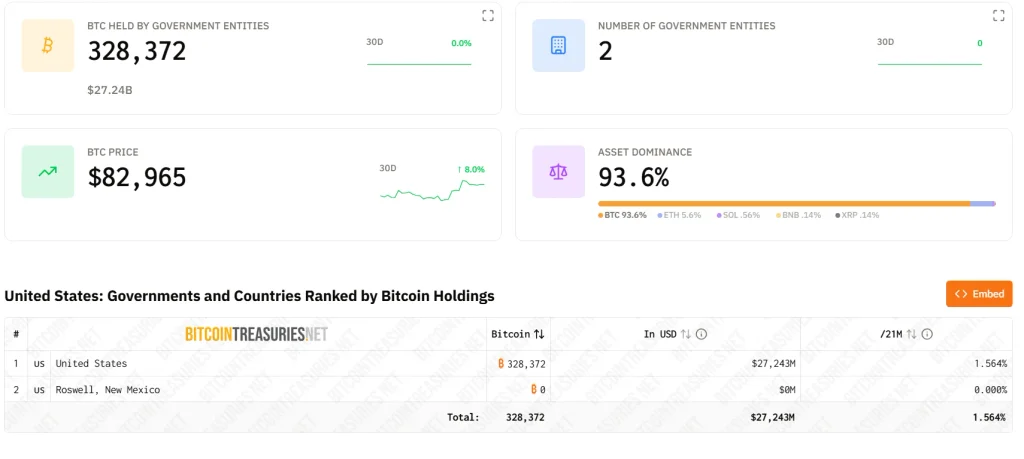
However, government Bitcoin can have different legal statuses. Some assets may be subject to forfeiture proceedings, victim claims, statutory requirements or other restrictions before they become eligible for permanent reserve treatment.
The October 2025 Prince Group case illustrates why this distinction matters. The DOJ said the 127,271 BTC was in government custody, but the forfeiture action itself remained part of a legal proceeding.
So the most defensible description today is “estimated U.S. government Bitcoin holdings of 328,372 BTC,” rather than “the Strategic Bitcoin Reserve holds 328,372 BTC.”
What Happens Next
As of September 28, 2026, ARMA remains at the House committee stage. The official House record shows that it was ordered to be reported as amended on September 16. It still requires further congressional action before becoming federal law.
The BITCOIN Act represents a separate route because it would create an actual 1 million-BTC purchase program. ARMA, by contrast, focuses on custody, reporting, long-term retention and studying budget-neutral acquisition methods.
That leaves the U.S. reserve policy with three clearly different layers:
- The executive order already established the policy and Treasury administrative framework.
- Government-held Bitcoin is estimated at 328,372 BTC, largely originating from forfeiture actions.
- Congress has not yet enacted the legislation that would create the stronger statutory custody and acquisition framework proposed in 2026.
The central question is therefore no longer whether the United States has announced a Strategic Bitcoin Reserve. It has.
The more important question is how much of the estimated government Bitcoin balance ultimately qualifies for the reserve, how Treasury reconciles and reports those holdings, and whether Congress authorizes a broader acquisition program beyond seized assets.